Friday, September 26, 2014

The Robe Shop

I spent the last two days battling jet lag and getting myself set up in my new room. Most of this involved buying exciting things like shampoo, Post-It notes, and tea. It's amazing how much you can get done in a day when your body wakes up naturally at 3:30 in the morning.

And then I got to buy my robes. Robes are to be worn at formal dinners, during any exams, and for sundry occasions. There are several types of robes at Oxford. For me, there are the fancy, colorful robes I'll be wearing at graduation and there are the "everyday" robes I'll be wearing at the aforementioned events. I bought my everyday ones. Graduate student everyday robes are different than those of undergrads, which are hilariously called "commoner robes" because they haven't earned any degrees yet to make them special. Graduate robes are longer and have these tapers that run down the back of the gown on either side. Since they are open-faced, the clothing worn underneath them, right down to the nylons and velvet ribbon, is regulation and is called "sub fusc". The hat is also a requirement. You have your choice of mortar board or soft cap. Mortar boards must be worn outside and must not be worn inside; soft caps must be worn at all times. I opted for the soft cap because once you resign yourself to hat hair, you don't want to be forced to take the cap off and display it.

Please excuse the crooked selfie; I don't know anyone yet who can take my picture.


I know, this outfit is so fetch. What would Giuliana say?
                                               A: Doesn't matter. I get to wear it!

There are a couple robe shops in town. Madam Malkin has competition.

Shepherd and Woodward, founded in 1845

Ede and Ravenscroft, founded in 1689

And just in case we hadn't established that I'm attending Hogwarts for muggles, here's living proof, located somewhere between the robe shops:


Yep, that's a broom. And wands. In the same shop as the university hoodies. NBD.

In Transit

I've arrived! And after a frustrating chat with the man at IT Services, who informed me that he would not help me until after next week's orientation seminar but that the instructions for how to get online could be found online, I now have my laptop hooked up to the campus wifi, which is the defining quality that makes a dorm a home.

Travel went off without a hitch, and in fact a few bonuses as well. Overbooking the flight led to my unwieldy carry-on being checked as baggage for free and I flew through customs and managed to catch the earlier bus to Oxford, which meant I arrived nearly two hours ahead of schedule. Huzzah!

Fun times were had in the Reykjavik airport. Their restrooms, for starters, look like futuristic labyrinths, or perhaps the Department of Mysteries as designed by IKEA. Slick white walls concealing slick white doors that seal seamlessly closed combined with shiny white ceilings and smooth white floors to near-blinding effect. The only way you could tell there were stalls were the small metallic handles intermittently punctuating the surfaces. And the halls between them curved around, twisting until you had no idea which way was up. Each stall was its own complete washroom -- toilet, sink, dryer, mirror, everything. And they sealed completely shut; no gaps between the floor and the walls. The sink hardware was a combination faucet and hand dryer. And yep, I took a photo.


Wave your hands under the main tube for water. Wave them under the side tubes for high-speed drying.

I then proceeded to buy whiskey at 6:30 in the morning (a gift I owe a friend), trying to convert Icelandic kroner to euros to dollars in my head on precisely four hours of sleep in the past 28 (because no one, even with the best intentions, sleeps the night before a transatlantic move).

Third and last, I now understand why the Doctor craved fish fingers in custard after his eleventh regeneration. By 6:45 am Iceland time, my brain was so fried that I had a sandwich of roast beef, brown mustard, sweet pickles, and soggy French onions for breakfast and thought that the only thing that could possibly make it a more satisfying meal was if I could wash it down with some tapioca pudding.

Doctor Who, Season 5, Episode 1, "The Eleventh Hour"
"Box falls out of the sky, man falls out of a box, man eats fish custard."

Monday, September 22, 2014

Tomorrow I'll Miss You


My flight leaves tomorrow! My last weekend has been spent playing Tetris with my carry-on, going on a last horseback ride and having dinner with with my family, and watching favorite movies with my mom. And double-checking that I have all my paperwork. Lots of paperwork.

I had originally intended to write a post entitled "Odd Things in My Suitcase", but as the crannies in my suitcases shrunk and the airline weight limit reared its small but non-negotiable head, I found myself cutting out all of the fun and quirky items and praying for the basics to fit. Two suitcases, a carry-on, and a "small personal item" is surprisingly little to work with when you consider I will be living out of them for a minimum of three years. Yes, I can buy things over there -- and I intend to -- but I'd rather use what I already own.

Anticipated time in transit: 17.5 hours
Layovers: 2, plus a switch from train to bus
The one odd item in my suitcase: a $2 bill


For everyone's enjoyment while I spend the next few days traveling and recovering from jet lag:


Thursday, September 18, 2014

To Be or Not to Be?

“fre liking is yharnyt our all other thing”

[“Free decision is longed for above all else.”]

This is part of one of the most famous passages in a medieval Scottish manuscript called The Brus (Modern English: The Bruce). Here is a slightly longer bit of the original:

A! Fredome is a noble thing
Fredome mays man to haiff liking.
Fredome all solace to man giffis,
He levys at es that frely levys.
A noble hart may haiff nane es
Na ellys nocht that may him ples
Giff fredome failyhe, for fre liking
Is yharnyt our all other thing.
                        Book I, lines 225-32

Ah! Freedom is a noble thing
Freedom lets a man have pleasure,
Freedom all solace to man gives,
He lives at ease who freely lives,
A noble heart will have no ease
Nor aught else that pleases him
If freedom fails, for free decision
Is longed for above all else.
                        Translation by A.A.M. Duncan


The author, John Barbour, wrote The Brus c. 1375. It’s a long narrative poem about King Robert I, the actual Braveheart (not William Wallace—sorry, Mel).

Today, Scotland is voting for or against its independence from the U.K. As an American and a medieval literature student, I have pretty much zero qualifications to be writing on this topic. Instead, I invite you to check out this website, which breaks down some of the major issues surrounding Scottish independence. We’ll see what tomorrow brings!

Monday, July 21, 2014

Say Hwaet?

Shakespeare did not write in Old English.

Shakespeare wrote in Early Modern English. In fact, the proper term for the Renaissance is “Early Modern,” because there were lots and lots of renaissances over the course of several centuries. A renaissance is a “rebirth” of classical knowledge. It means that people are suddenly really interested in what the Romans and Greeks were doing, the local monasteries clean up their act like frat boys the night before Moms’ Weekend, and everyone starts using Latin a lot more. The Renaissance hit its height in the 16th century, but arguably spanned from the 14th all the way to the 17th century. To distinguish this über-renaissance from the rest of the renaissances, historians refer to this period as Early Modern.

So if Shakespeare is Early Modern, what constitutes Old English?

Let me give you a visual and an audio. If you click the link below each passage, it will take you to a YouTube video where you can hear the words pronounced. (Trust me, you’ll want to do this—Middle English may look normal-ish, but it sure doesn’t sound like it.)

4th to 11th century: Old English, also known as Anglo-Saxon
hƿæt ƿe ȝardena in ȝeardaȝum,
þeodcyninȝa, þrym ȝefrunon,
hu ða æþelinȝas ellen fremedon.
oft scyld scefinȝ sceaþena
þreatum, moneȝum mæȝþum, meodosetla ofteah,
eȝsode eorlas. syððan ærest ƿearð
feasceaft funden, he þæs frofre ȝebad,
ƿeox under ƿolcnum, ƿeorðmyndum þah,
oðþæt him æȝhƿylc þara ymbsittendra
ofer hronrade hyran scolde,
ȝomban ȝyldan. þæt ƿæs ȝod cyninȝ.
Just to clarify, the ȝ and ƿ should blend in size-wise with the rest of the text, but unfortunately there is no Unicode for these runes, so I had to copy-paste pictures of them into the text rather than be able to type them or insert them as symbols.

11th to early 15th century: Middle English
Whan that Aprill with his shoures soote
The drought of March hath perced to the roote
And bathed every veyne in swich licour,
Of which vertu engendred is the flour;
Whan Zephirus eek with his sweete breeth
Inspired hath in every holt and heeth
The tendre croppes, and the yonge sonne
Hath in the Ram his halfe cours yronne,
And smale foweles maken melodye,
That slepen al the nyght with open eye-
So priketh hem Nature in hir corages;
Thanne longen folk to goon on pilgrimages
And palmeres for to seken straunge strondes
To ferne halwes, kowthe in sondry londes;
And specially from every shires ende
Of Engelond, to Caunterbury they wende,
The hooly blisful martir for to seke
That hem hath holpen, whan that they were seeke.

Late 15th to 17th century: Early Modern English
To be thus, is nothing, but to be ſafely thus:
Our feares in Banquo ſtick deep,
And in his Royaltie of Nature reigns that
Which would be fear’d. ’Tis much he dares,
And to that dauntleſs temper of his Minde,
He hath a Wiſdom, that doth Guide his Valour,
To act in ſafety. There is none but he
Whoſe being I do fear, and under him
My Genius is rebuked, as it is said
Mark Anthonies was by Ceſars.
The weird squiggle (ſ) that looks like a fancy letter 'f' is an 's'; our normal letter 's' was used at the end of words, and the squiggle was used at the beginning and in the middle of words. And yes, that’s Ian McKellan. Judy Dench plays Lady Macbeth in the same Royal Shakespeare Company production.

The biggest difference between Middle English and Early Modern English, in my opinion, is the way in which words were pronounced. Middle English is spoken farther back in the mouth and sounds more German; Early Modern is pronounced almost like we pronounce words now. To get a really accurate idea of what Shakespeare's accent sounded like (even better than Gandalf can do), here's a neat YouTube video.

I stole parts of this post from a blog I had a few years ago. I figured the information had not changed and there was no point in tracking down completely different quotations and video links. So if you're having a sense of déjà vu, that's why.

What's My Line?


As I mentioned in my initial post, I will be pursuing a doctorate in English. The study of English language and literature encompasses several continents and fifteen centuries. So to be a little more specific, I will be studying Medieval English literature with an emphasis on insular romances and ballads.

Um, what?

I did my Bachelor's in English (general literature) and my Master's in Medieval Studies (which means a combination of literature, history, theology ... basically anything to do with the Middle Ages).

The dates of the Middle Ages are a little fluid. It started earlier and ended later in England than it did in, say, Italy. Mostly this has to do with the fall of the Roman Empire and the start of the Renaissance. So for the purpose of this blog, when I talk about the Middle Ages I'm referring to a period from roughly 500 - 1500 C.E.* Basically from the retreat of the Roman Army from the British Isles to the start of the Tudor reign. So no Henry VIII for me. 

Insular means that I will be looking at stuff written in the British Isles, not on the Continent. And it will be in Middle English. More on what constitutes Middle English (verses Old or Early Modern English) later. 

What I do:


What I do NOT do:

Photo from www.medievalarchives.com

Nope. Do not do.  So when I say I am attending a Medieval conference, this is what I'm doing:

Photo from www.medievalists.net

Photo from www.patriciabracewell.com

Photos from the International Medieval Congress at Western Michigan University

NOT this:

Photo from www.haerr.blogspot.com

Not to take away from people who enjoy doing that sort of thing; it's just not my cup of tea. Or what I'm paying tuition for. 


*C.E. stands for Common Era. It is exactly the same as A.D., and B.C.E. (Before Common Era) is exactly the same as B.C. The difference is that A.D. and B.C. are strictly Christian (Anno Domini, the Year of Our Lord, and Before Christ) and C.E. and B.C.E. are a little more secular, and therefore viewed by many historians, publishers, etc. as more professional.

Tuesday, July 15, 2014

Fun with Flags

"Flags: you gotta know how to hold 'em, you gotta know how to fold 'em." -- Sheldon Cooper, The Big Bang Theory

The Union Jack is a rather complicated flag. It is a compilation of the flags of England, Scotland, and Northern Ireland, which, as I talked about in the previous post, comprise the United Kingdom.
Photo from www.picturesofengland.com

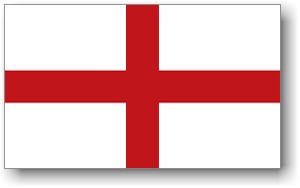
The flag of England, also called St George's Cross.

Photo from www.wikipedia.org

The flag of Scotland, or St Andrew's Cross/Saltire.

When King James VI of Scotland inherited the English and Irish thrones and became James I of England and Ireland as well, he combined the flags of England and Scotland and created what he called the flag of Britain.

Photo from www.wikipedia.org

Ta-da! How clever of him.

This became the national flag from 1606-1801. In 1801, they finally added the Irish flag to the mix, which was only fair considering Ireland had been part of the nation since 1603.


Photo from www.wikipedia.org

The flag of the Kingdom of Ireland, or St Patrick's Cross. For the vexillology purist, St Patrick's Saltire.


So with all three flags combined, voilà! The modern Union Jack sprang into being.


Photo from www.wikipedia.org

How to tell if your Union Jack is flying right-side up? Look at the saltires (the X, not the +). In vexillology (the study of flags), as with heraldry, the top left corner is the most important corner. Since Scotland's flag was part of the Union Jack before the Kingdom of Ireland's flag, the white part (St Andrew's Cross) goes on top and the red part (St Patrick's Cross) goes on the bottom. If your Union Jack is the wrong way 'round, the red part will be on top, which is incorrect.