Um, what?
I did my Bachelor's in English (general literature) and my Master's in Medieval Studies (which means a combination of literature, history, theology ... basically anything to do with the Middle Ages).
The dates of the Middle Ages are a little fluid. It started earlier and ended later in England than it did in, say, Italy. Mostly this has to do with the fall of the Roman Empire and the start of the Renaissance. So for the purpose of this blog, when I talk about the Middle Ages I'm referring to a period from roughly 500 - 1500 C.E.* Basically from the retreat of the Roman Army from the British Isles to the start of the Tudor reign. So no Henry VIII for me.
Insular means that I will be looking at stuff written in the British Isles, not on the Continent. And it will be in Middle English. More on what constitutes Middle English (verses Old or Early Modern English) later.
What I do:


What I do NOT do:

Photo from www.medievalarchives.com
Nope. Do not do. So when I say I am attending a Medieval conference, this is what I'm doing:

Photo from www.medievalists.net
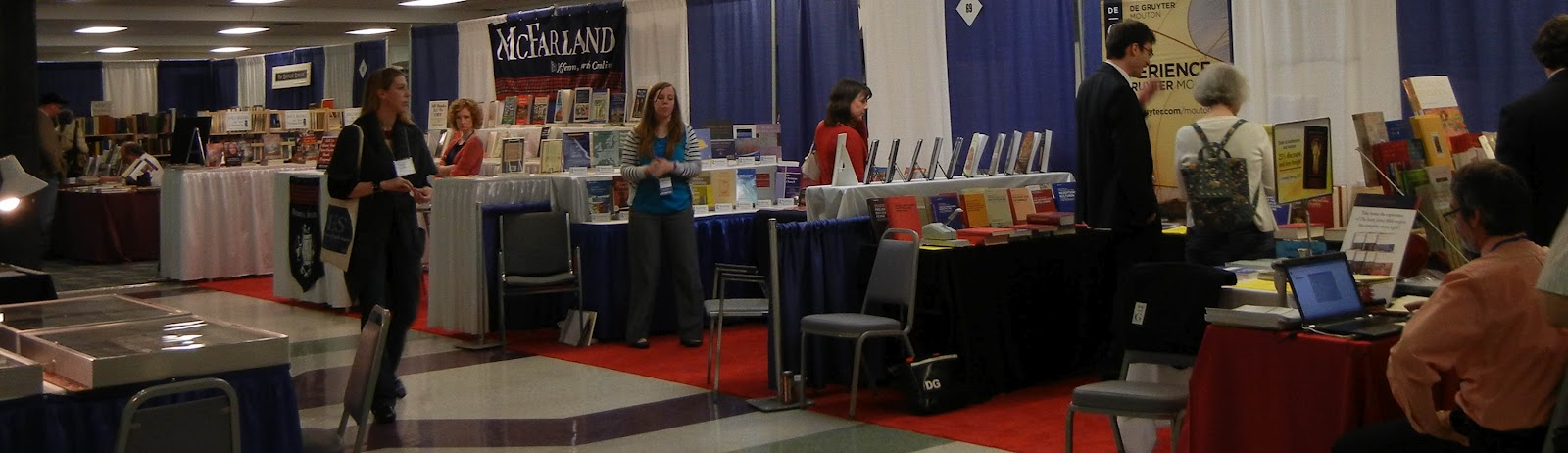
Photo from www.patriciabracewell.com
Photos from the International Medieval Congress at Western Michigan University
NOT this:

Photo from www.haerr.blogspot.com
Not to take away from people who enjoy doing that sort of thing; it's just not my cup of tea. Or what I'm paying tuition for.
*C.E. stands for Common Era. It is exactly the same as A.D., and B.C.E. (Before Common Era) is exactly the same as B.C. The difference is that A.D. and B.C. are strictly Christian (Anno Domini, the Year of Our Lord, and Before Christ) and C.E. and B.C.E. are a little more secular, and therefore viewed by many historians, publishers, etc. as more professional.

No comments:
Post a Comment